
Ponytails and Braids with Hair Extensions
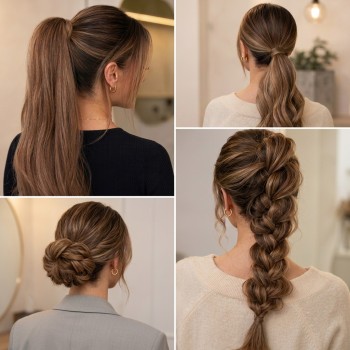
Ponytails and Braids with Hair Extensions — How to Wear Your Hair Up Without the Clips Showing
When we picture hair extensions, we usually imagine long, flowing, voluminous hair worn down. But a beautiful hairstyle doesn't stop there. Extensions can be a wonderful way to create a striking high ponytail, low ponytail, braid, or elegant bun — even when your natural hair is shorter or finer.
There is, however, one small question that often worries women: "Won't the clips show when I put my hair up?"
In most cases — no. The key lies in the right placement and distribution of the extensions.
The secret is the correct clip height, good hair distribution, and enough natural hair left to cover the attachment areas. With a few simple techniques, you can wear your favorite updos without the extensions looking like a separate element.
1.Why does an updo need a bit more attention?
When hair is worn down, most of the clips stay hidden under the falling hair. In a ponytail or braid, though, the hair moves differently, and the attachment areas can become more visible.
That's exactly why, for an updo, it isn't enough to simply place the extensions and then gather everything with a hair tie.
You need to think ahead about where the style will sit and how the hair will fall around it.
For example, with a high ponytail, the area around the crown and upper nape stays much more exposed. With a low ponytail, you can use the natural hair that falls downward to more easily cover the clips.
So the first rule is:
Choose the placement of the clips based on the hairstyle you want to create.
2.How to prep your hair before placing the extensions
A good foundation matters for any hairstyle with extensions.
Before you start, brush your hair carefully from the ends toward the roots to remove any tangles. If the hair is too slippery or freshly washed, the clips may have less grip.
For finer or very smooth hair, you can lightly backcomb the roots at the spots where the clips will sit.
There's no need to backcomb all of the hair — just enough to create a little texture at the base.
You can then part the hair into horizontal sections. Working this way lets you place the extensions gradually and control exactly where the volume is created.
3.How to place the clips so they stay hidden
This is the most important part.
If you're going for an updo, don't place the clips right where the hair tie will sit.
Instead, leave enough natural hair above them.
If you're planning a high ponytail, start placing the extensions from the lower part of the nape and gradually work your way up. Leave the last section as natural hair, to cover the top clips. That final layer of natural hair needs to be thick enough to fully cover the top clips.
This matters especially if you're planning a high ponytail or a braid.
4.High ponytail with extensions
The high ponytail is one of the most feminine and striking hairstyles, but it's also the one that needs the most care when placing the clips.
First, decide roughly where you want the ponytail to sit. Then place the extensions lower than that point.
It's not a good idea to put a large row of clips right below the hair tie, because they can show once the hair is gathered up. It's better to spread the volume across a few lower rows instead.
Once all the extensions are in place, brush your natural hair down over them and comb it carefully. Gather the hair into a ponytail without pulling it too tight.
A small trick for a more natural high ponytail
If you want the ponytail to look a bit more effortless and modern, don't smooth down every single strand.
Leave a few fine face-framing pieces loose and let the hair at the crown relax slightly.
This softens the style and makes the transition between your natural hair and the extensions far less noticeable.
5.Low ponytail with extensions
The low ponytail is even easier to pull off.
Since the hair falls downward, you can place the extensions a little higher up without worrying that the clips will show.
The low ponytail is a great choice for everyday looks, the office, an evening event, or a more elegant hairstyle.
For a more polished result, you can smooth the hair with a brush and leave one thin strand to wrap around the hair tie.
That way, even the simplest ponytail looks like a professionally styled look.
6.Braids with extensions — more length and much more volume
Braids are one of the best ways to use extensions. The reason is simple — once the hair is braided, the extra length and thickness create a much richer visual effect.
You can go for:
- a classic braid
- a French braid
- a Dutch braid
- a fishtail braid
- a loose boho braid
- two braids
- a side braid
With braids, the most important thing is to position the clips so that your natural hair covers them before you start braiding. If you start braiding directly from an area with a visible clip, it can end up on the surface.
So cover the attachment points first, then start shaping the braid.
7.How to make a braid look visually fuller
Once you've finished braiding, you can gently tug on the outer sections of the braid.
Don't pull hard — work gradually. This small trick creates a sense of greater volume and makes the braid look softer and more natural.
With hair extensions, the effect is especially beautiful, because the extra length lets the braid be bigger and fuller.
8.And what about a bun?
Extensions are also a great foundation for a bun.
If your natural hair isn't thick enough, a bun can end up looking small and "empty." The extra volume from the extensions solves exactly that problem.
- For a low bun, you can place the extensions in the lower and middle sections of the hair, then gather everything and shape the bun.
- For a more relaxed result, leave a few loose face-framing pieces.
- For a formal hairstyle, you can smooth the hair and secure the bun with pins.
9.How much extension hair do you need for an updo?
You don't always need the full amount of extensions you'd wear with your hair down.
If your goal is simply to add length, you may need less hair.
But if you want a very full ponytail or a large braid, you'll need more hair to achieve a balanced volume.
When deciding on the amount, take into account:
- your natural hair density
- the desired length
- the desired thickness
- the type of hairstyle
- the placement method
For finer hair, it's better to distribute the amount evenly, rather than creating too much volume in just one area. For more advice on the right weight/amount*
10.5 mistakes that can give the clips away
1. The clips are placed too high
This is one of the most common reasons they end up showing. Leave enough natural hair above them.
2. All the extensions are bunched in one spot
This creates too much concentrated volume and makes the style harder to shape.
3. The ponytail is pulled too tight
When the hair is pulled too tight, the clips can shift or become visible.
4. The color doesn't match well
Even when a clip is hidden, a difference in color between your natural hair and the extensions can still be noticeable. That's why choosing the right shade matters so much.
5. The natural hair and extensions have different textures
If one part is completely straight while the other is wavy or curly, the transition can become more noticeable.
11.Clip-in extensions or a ready-made ponytail?
If you love wearing a ponytail often, a ready-made ponytail extension is an extremely practical option.
It's designed specifically for quickly adding length and volume, and can turn an ordinary ponytail into a finished hairstyle in just a few minutes.
If you want more freedom and enjoy experimenting with different hairstyles, clip-in wefts are the more flexible option. You can decide for yourself where to place the hair and how much volume to add.
They work not just for hair worn down, but also for ponytails, braids, buns, and various formal hairstyles.
12.How to make extensions look natural
The most important thing is to think of the extensions as an extension of your own hair, not as a separate piece.
Choose the right color, match the amount to your natural density, and distribute the hair evenly.
If needed, you can lightly curl or straighten your natural hair and the extensions together, so their textures blend.
The better the two blend together, the more natural the final result will look.
13.A beautiful updo starts with the right placement
Extensions don't mean you're limited to wearing your hair down.
With the right technique, you can wear a high ponytail, low ponytail, braid, or bun without the clips showing.
The most important thing is to plan the placement around the hairstyle you want to create. Leave enough natural hair above the clips, distribute the extensions evenly, and avoid pulling too tight.
And when you add quality natural hair, the right shade, and proper care to all of that, the result can look completely natural and stunning.
Extensions aren't just a way to add length and volume to your hair. With the right placement, you can turn them into part of almost any hairstyle — from an effortless high ponytail and a romantic braid to an elegant bun.
The key is to match the placement to the hairstyle you want to create, choose the right shade and amount of hair, and leave enough natural hair to cover the clips.
That way, you can enjoy more length, more volume, and so much more freedom to change up your look — whenever you feel like it.
Because beautiful hair isn't just about length. It's about being able to wear it exactly the way you love.
Write a comment